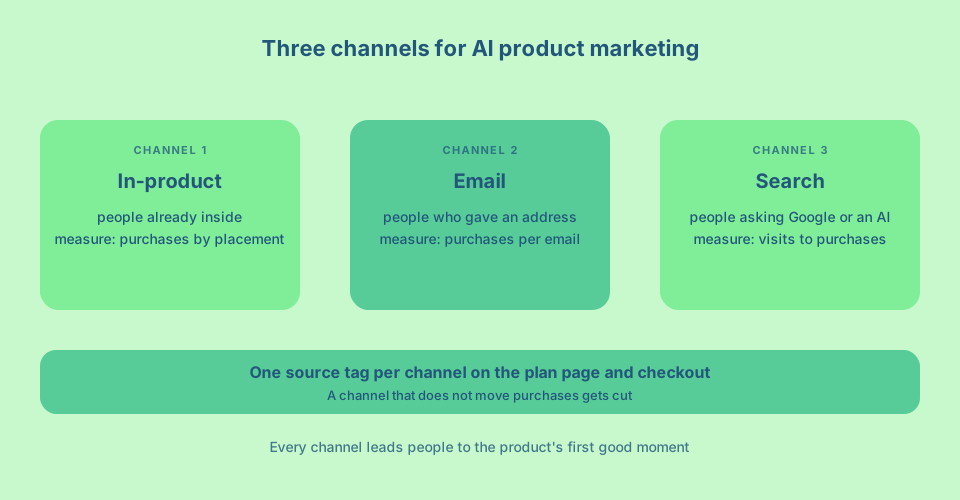
To structure marketing for an AI product, split it into three channels and treat each one as its own small business. In-product marketing reaches people already inside your product. Direct marketing, mostly email, reaches people who gave you their address. Search marketing reaches people who are asking Google or an AI assistant for help and do not know you yet. Give every channel an audience, a message and one number, and judge it by purchases, not by clicks.
I am Ash, and I have spent a decade building software and now help businesses with the shift that large language models (LLMs) brought. This article is for the people who decide where the marketing effort goes, which means marketing teams, product managers, founders and senior leaders. It follows the way I plan the launch of a paid plan for a small AI product.
Why does an AI product need its own marketing structure?
An AI product is easy to start and hard to explain. A team can ship a working agent in a week and then find that nobody understands from the homepage what it does, what it costs or what it cannot do. The usual response is to try everything at once, and six weeks later nobody can say which effort produced a customer.
A structure fixes that. When every channel has an owner, a message and a measure, you can tell what works and stop what does not. This is the way of thinking in Alex Schultz’s book Click Here, which is about choosing among the many available channels, testing what you say in them and measuring the gain each one adds on its own. I apply it to a small team, where the three channels below have an unfair advantage because they use things you already own, which are your product, your list and your content.
Start with the first good moment
Before you choose a channel, decide what the first good moment of your product is. It is the moment a new user feels the product did something useful for them. For an AI note taker it could be the first meeting summary. For a support agent it could be the first email draft that the user sends without changes.
Marketing amplifies a product that people keep using. If you bring a thousand people to a product where only twenty reach the first good moment, you have bought a leaky bucket. So the first job of every channel is to get people to that moment, and the second job is to bring in the next person.
Write it as one sentence and measure how many new users reach it in their first two weeks. That number tells leadership more than the number of signups.
Decide who it is for and why they would pay
Channels come after positioning. Before you choose where to speak, write down five things. Who is the specific person or company most likely to buy? What costly, urgent problem do they have? What outcome do you promise? Why you, instead of the alternatives? And what proof shows that the product delivers?
The question that is specific to AI is this one. Why would someone pay for your product when they could ask a general-purpose AI assistant to do the same thing? Good answers are your own data, continuous monitoring, a workflow that runs without anyone typing a prompt, integrations, or a measurable business result. Lead with the result, such as “ship database reports in 30 seconds without waiting on the data team”, and not with the technology, such as “powered by LLMs”.
Answer the trust questions before buyers ask
Trust is the largest source of friction for AI products. Most buyers have the same few questions, and your marketing should answer each one in the open.
| Buyer question | What to show |
|---|---|
| Is it accurate? | Real outputs, how you check them, and what the product cannot do. |
| Can I do this with a general AI assistant? | The full workflow, saved data, automation and time saved. |
| Is my data safe? | Plain statements on retention, training use and access, and only the security badges you really hold. |
| Will it work for my business? | A sample, a demo or a trial on their own data. |
Channel one: In-product marketing
In-product marketing is everything you say to people while they use your product. It is the cheapest channel because the audience is already there, and in most small products it is also the largest.
The rule is to speak at the moment the message makes sense. An upgrade card shown on day one is noise. The same card shown right after the user got a good result is a natural next step. Attach each offer to a real event, such as the first result arriving or the user finishing a task, and say what the next step would be in the user’s words, not as a list of features.
A few placements work in almost any AI product.
- A short, calm offer after the user got value, shown at most once per month per account.
- A pricing page that states plainly what is included, what is not included and what happens when a limit is reached.
- A checklist for new paying users, so they reach the first good moment instead of buying and forgetting.
Honesty is a marketing tool here. If a limit means that sending waits until next month, say so on the page. A counter, such as seats left in a limited offer, must be a true number or it should not be shown.
To measure the channel, count purchases by placement, so you know whether the card, the pricing page or the reply prompt did the work. Then count activation, which is the share of new paying users who reach the first good moment within 14 days. If activation is low, fix the product before you spend more on the other channels.
Channel two: Direct marketing
Direct marketing reaches people who gave you their email address and have a reason to hear from you. It is the channel that brings back a user who tried your product once and left, because email reaches the person and not the page.
Keep the list of emails short and tied to events. Each one should exist because something happened or something is about to change.
- Two onboarding emails in the first week, which explain how to reach the first good moment and mention the paid plan once.
- One launch announcement for a new plan, with the price, the limits and the refund terms.
- A welcome sequence for new paying users, one email per setup step.
- One email at the end of a cancelled plan that says what keeps working.
There is no weekly newsletter and no “just checking in” message. A small list sent with care beats a big list sent often.
Send plain text from a real person’s name, with one link that matters and an unsubscribe link in every message. Send marketing only to your own customers, never to people that a customer invited through your product. Cap marketing at one email per person per week.
The reason is sender reputation. Your product emails (invites, receipts, alerts) share it with your marketing, so if marketing pushes the complaint rate up, the emails your product depends on start landing in spam. Watch unsubscribes and spam complaints for every email, and count clicks and purchases per email. I do not judge an email by its open rate, because mail apps often load images automatically and an open does not mean a person read anything.
Channel three: Search marketing for SEO and GEO
Search marketing reaches people who are not in your product yet and are looking for a solution. Search engine optimization (SEO) is about being found when someone types a query into a search engine. Generative engine optimization (GEO) is about being mentioned when someone asks an AI assistant for a recommendation. The term comes from a research paper from Princeton University and other institutions that tested which changes to web content make it appear more often in AI-generated answers.
For a young product the traffic from search is small and grows slowly, but it compounds, because a page that answers a question well keeps working for years.
Google says its AI features in search use the same foundation as classic search. A page needs to be indexed and eligible to appear as a snippet, and the usual good practices still apply, according to Google’s guide to AI features and your website. You do not need a separate strategy. You need good pages, and these are the ones I would build first, along with articles that solve the problem your product solves for someone who has not heard of you.
- A pricing page written as plain text, with prices, limits, what is not included and the refund policy, so a search engine or an assistant can quote any part of it.
- A short FAQ on that page that answers the questions people type, such as whether a product has a lifetime plan.
- An honest comparison page with named, checked prices and the date they were checked, because people will compare you anyway.
The technical side of being readable by machines, including structured data, is in How to market your AI Agent.
Do not promise rankings or AI citations to anyone, including your own leadership, because nobody controls them. Measure visits from search engines and AI assistants to these pages and the purchases that start from them.
How do the three channels work together?
Search brings a stranger to an article, and the article links to the pricing page. In-product marketing helps the new user reach the first good moment and offers a plan at the right time. Email brings them back if they leave. A happy user who leaves a review becomes content for the search channel.
Do not measure them together. Give each channel its own source tag on the pricing page and the checkout, so every purchase says where it came from. A channel that does not move purchases gets cut instead of turned up. That one rule saves more budget than any clever tactic.
Who owns what in a small team?
The structure is mostly a decision about who is responsible for what.
- The product manager owns in-product marketing and the first good moment, because the messages live inside the product.
- The marketing lead owns email and search, and the weekly review of purchases by channel.
- The founder or senior leader owns the claims, so every promise in the copy is something the product does today and not something on the roadmap.
- Engineering owns source tags, event tracking and making sure pages send real text in the HTML.
Give leaders a dashboard with one row per channel, showing purchases and the single metric it is judged by. Add one more row for gross margin after AI costs. Model usage, hosting and support can make a channel that brings many customers unprofitable. Decide the stop rule before launch too. If fewer purchases than an agreed number arrive in the first 30 days, pause new work and talk to the people who looked at the page and did not buy.
Frequently asked questions
What is the first marketing channel an AI startup should focus on?
Start with in-product marketing, because the audience is already inside your product and it costs almost nothing. Email comes second because it reuses the same users. Start search early too, because it takes months to show results.
Why would anyone pay when a general AI assistant can do the same thing?
They pay for what the assistant does not give them, which is your data, a workflow that runs by itself, saved history, integrations and a result they can measure. Say that on the page in one sentence.
Is GEO different from SEO?
They overlap a lot. Readable pages, clear headings and honest content help both. The difference is what you measure. SEO measures rankings for a keyword, and GEO measures whether an AI assistant mentions and recommends you when someone asks a question. I wrote a six-step guide to doing that in How to market your AI Agent.
A plan for your first 30 days
- In week one, write the first good moment as one sentence and measure how many new users reach it today.
- In week two, add source tags to your plan page and checkout, and place one honest offer inside the product at the moment of value.
- In week three, write the onboarding emails and the cancelled plan email, and set the weekly email cap.
- In week four, rewrite the pricing page as plain text with a short FAQ, and publish one article that answers the most common question your customers ask.
- At the end of the month, look at purchases by channel and cut the one that did nothing.
Structure does not need a big team, only a decision about who looks at which number every week. If you want your shared links to look good, I wrote about dynamic social preview images too. Good luck, and let me know what you find.