To get engineering teams to adopt an internal developer platform (IDP), make the platform’s path the easiest way to do the jobs every team has, let teams get what they need by themselves instead of filing tickets, and measure whether teams keep choosing it. Mandate the outcomes you must have, such as an owner for every alert and a way to roll back, and make the platform the easiest way to meet them. The Cloud Native Computing Foundation (CNCF) says it plainly in its platforms white paper. Platform teams “that rely on top-down mandates to achieve adoption are almost certain to find resistance and resentment from their users and miss a lot of the promised value”.
I am Ash, a Staff engineer in Toronto. At a company I worked at, I led the migration of 120 services to Kubernetes, and I built the paved road on top of it. That is one deployment template with health checks, resource limits and rolling deploys, and all 120 services deploy through it, so no team writes its own infrastructure. This article is for staff engineers and engineering leaders who own a platform, or are about to. I link the sources behind the method and say where something is my opinion.
What a golden path is, and why teams use it
A golden path is a supported, opinionated way to do a common job, such as building and shipping a new service. Some companies call it a paved road. The CNCF describes the usual shape as “an initial project template and documentation, a bundle often described as a golden path”. Spotify defines it in its engineering post on golden paths as the “opinionated and supported” path to build something.
Teams use it because it takes decisions away. Spotify says that with golden paths in place, teams do not have to reinvent the wheel and “have fewer decisions to make”. Before them, the only way to find out how to do something was to ask a colleague, which Spotify called “rumour-driven development”.
Why teams ignore a platform and build their own
Teams ignore a platform when their own way is easier. The platform competes with a script that one engineer wrote in an afternoon.
The DevOps Research and Assessment (DORA) programme lists the common ways to lose that contest on its platform engineering page. The “Build it and they will come” trap is a platform built with no user research. The “Ivory tower” is a central team that dictates standards, which DORA says leads to “shadow IT” workarounds. The “Ticket-ops” trap is a team that acts as a “vending machine” for infrastructure tickets. Two more are the “Big bang” release and the rigid “golden cage”.
The CNCF platform engineering maturity model shows the starting point. At its first level, “Product teams each maintain their own set of scripts or tools to deploy their applications.” Your platform replaces those scripts, and each one is a clue to a job that the platform did not do well enough.
Make the platform road the easy one
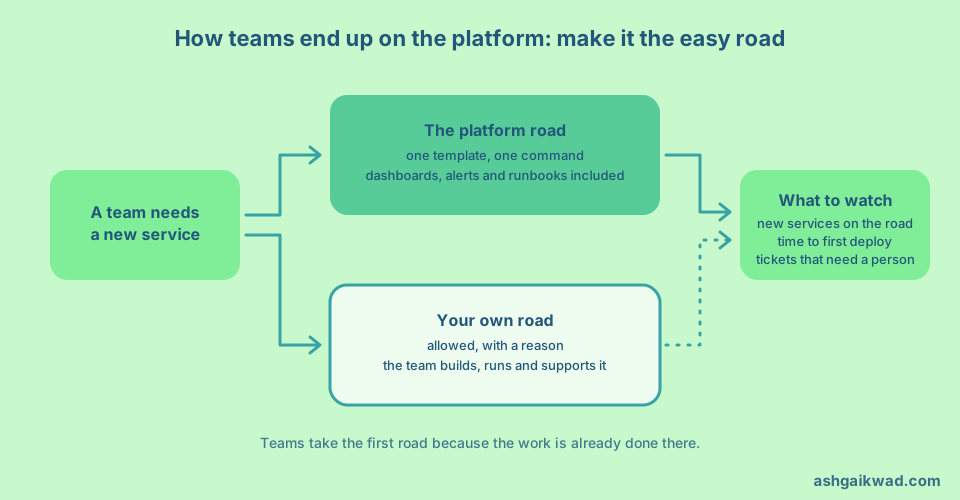
The whole method is one sentence. The platform road must cost a team less than its own road, on the day they start and on the day something breaks.
Start with the journey almost every team takes. DORA says to “identify the golden path for the most common workflow and build just enough to make that specific journey demonstrably better”. Team Topologies calls the same idea the Thinnest Viable Platform and says a good platform should “make stream-aligned teams move faster, not generate more dependencies to manage”. For most companies that journey is a new service.
Put the work nobody wants on the road. A deployment template is the obvious part, and in my opinion what comes with it is what wins teams over. Alongside the template I added CI/CD guardrails (required checks, staged rollouts and automatic rollback), per-service dashboards and alerts, and runbooks, and I routed each alert to the team that owns the service. Mean time to recovery fell by 80%, and on-call load fell by 80% after I removed the noisy alerts. A team on its own road builds its own rollback and its own paging, and that is the cost the platform road removes.
Let teams serve themselves. The CNCF puts it as a requirement: “Users must be able to request and receive capabilities autonomously and automatically.” DORA lists a queue of tickets as a trap, and reports that developer independence, “the ability to perform tasks without relying on an enabling team”, resulted in a 5% improvement in productivity at both the team and individual levels. I wrote a Go command-line suite as the self-service side of the internal developer platform. Engineers run common operations work themselves, and manual support during production incidents fell by over 90%.
Make failure readable. DORA’s 2025 data found that the platform capability most correlated with a positive experience is giving “clear feedback on the outcome of my tasks”.
Keep the road and its instructions the same thing. When people say Spotify’s tutorial is too long, the answer is to shorten the road: “we need to make the actual Golden Path easier to follow and with fewer steps”. I wrote down the standards that took new-hire onboarding from 3 weeks to 2 days, and standards a new person can follow in two days are ones a busy team can follow without asking you.
What to standardise, and what to leave to teams
Standardise what costs other people when it varies, and leave the rest alone. In my opinion that is a short list. How a service is built and deployed, how it reports health, how much it may use, who owns it, who is paged and how a bad release is rolled back should be the same everywhere, because a team that gets these wrong hurts the people on call, the neighbours on a shared cluster and the auditors who ask for evidence.
Leave the choices that only affect the team, such as the language, the framework and the internal design. The CNCF says a platform must be “composable” and enable teams “to use only parts of its offerings”, and that a team should be able to run its own capability when the platform has none. Its example is a product that needs a graph database the platform does not provide. DORA adds that a central team cannot and should not build everything, so a good platform has clear APIs and a contribution model. Standardise too much and you build a golden cage. Standardise too little and you are back at the first level of the maturity model.
Should the platform be mandatory?
Make the outcomes mandatory and the road the default, and earn the rest. The CNCF maturity model describes two stages. At the stage it calls “Extrinsic push”, adoption comes from incentives such as “personal reviews” and mandates such as “requiring use for production releases or receiving funding”. At the stage it calls “Intrinsic pull”, users are drawn by “the values of these platform offerings themselves” and end up “self-selecting into platform capabilities”.
A push is not wrong. The danger is staying there. The model’s own example of push is an organisation that tells everyone to use one deployment tool, and it notes that this is hard for teams “whose needs are not met by the new process but do not understand or are not allowed to extend it”. My order would be to offer the road to a few teams that want it, make it the default for new services once it works, and require only the outcomes that protect other people.
The team that will not move
Ask why before you decide what it is. A team that refuses the road usually has one of three reasons. The road does not fit their work, they do not trust it, or it costs them more than their own way. The first and third are product feedback, and DORA says to design the platform so other teams can extend it.
If the reason is real, let them leave and make the leaving honest. Spotify’s first golden path write-up, quoted in its post, says that an adventurer can leave the path “but then you will not have the same support”. I would add three rules, and they are opinions. A team that leaves owns the full cost of its road, including the pager, the rollback and the audit evidence. The exception is written down with a reason, an owner and a date to look at it again. If three teams leave for the same reason, that reason becomes a feature of the road.
If the reason is habit, give them time and help, and then set a date. Spotify has explored what it calls a “Golden State”, “a list of checks that engineers can use to know if their systems are following the Golden Path”. A sponsor in the executive team helps with the date, because the CNCF says platform teams “must seek support of enterprise leadership”. A sponsor cannot make the road good.
How to measure adoption
Measure choices and outcomes, not logins. The CNCF suggests measuring the time from a request to its fulfilment, and for a new user to submit a first code change. DORA adds that you should survey developer satisfaction and “measure the rate of new teams onboarding to the platform and the rate at which they continue to use it”. On one page I would put these.
- The share of new services that start on the road, and the share of all services on it.
- Time from “I need a new service” to its first deploy.
- How much work still needs a person, in everyday requests and in incidents.
- How many exceptions are open, and for how long.
- A short satisfaction question, asked on a schedule.
Watch the delivery numbers too. DORA warns that platforms “can sometimes lead to a decrease in throughput and change stability if not carefully managed”, and that the effect often follows a “J-curve”, with a dip before performance recovers.
What it costs
A platform road is a product, and it has product costs. DORA says to assign a product manager and treat developers as customers. Someone has to keep the documentation true, because Spotify says that when it spread ownership of its tutorials across many teams, it lost the coordination that a writer used to provide. Someone has to answer questions, so the road needs people whose job is the road. When every service deploys through one template, a fix reaches every service, and so does a mistake, so I would put the template behind the same checks and staged rollouts as any other production change.
Here is what I would not do. I would not start with a portal, because a portal on top of a slow road only makes the slowness easier to see. I would not launch with a ticket form and promise to automate it later, and I would not announce a mandate before one team has said that the road helped them.
DORA also reports that AI adoption helps organisational performance when platform quality is high and has a negligible effect when it is low. If agents write code in your company, my article on guardrails for AI coding agents describes the checks that belong on the road.
A plan for the first quarter
- Pick the journey with the most pain, such as a new service, and time every step with two engineers who do it.
- Build the thinnest road that removes the worst steps, with deploy, rollback, dashboards and alert routing.
- Give it to one or two teams that want it, and fix what they find before you tell anyone else.
- Replace every ticket you can with a command that works alone, and count the rest.
- Write the exception rule before the first exception arrives.
- Publish the one-page numbers each month, including the bad ones.
- When the road is good, make it the default for new services and keep only the outcome rules mandatory.
My own template was built on the clusters from a move to Kubernetes, which I describe in how to migrate many services to Kubernetes without downtime. A platform is done when a team picks it without being asked, and until then it is a draft.
Frequently asked questions
What is a golden path in an internal developer platform?
It is the supported, opinionated way to do a common job, such as creating a service, packaged as a template with documentation. Some companies call it a paved road.
Should an internal developer platform be mandatory?
Make the outcomes mandatory, such as ownership, alert routing and rollback, and make the road the easiest way to meet them. The CNCF warns that top-down mandates for adoption meet resistance.
Why do engineers build their own tooling instead of using the platform?
Usually because their own way is faster or fits their work better. Treat each home-made script as feedback about a job the platform does badly.
What do I do about a team that refuses to move?
Find out why. If the road does not fit, extend it. If it does, set a date, help them move and give them a check they can run themselves.